Your development backlog keeps growing while hiring another full-time engineer stalls. Some outsourcing platforms have raised rates or delivered inconsistent code quality, pushing teams to look for alternatives. Choosing the wrong virtual assistant wastes both budget and sprint time.
This article breaks down what to check before you commit: technical skills, vetting depth, and time zone overlap. You will get a ranked comparison of seven providers, including pricing and replacement terms, plus a clear number one pick and a framework for matching your tech stack, budget, and management style.
What to Look For in Software Development Virtual Assistants
Hiring a software development virtual assistant is not the same as hiring any other remote assistant: you need someone who can read code, work within your stack, and collaborate across time zones without constant hand-holding.
Software development VAs are a specialized subset of remote staffing, and the gap between a strong hire and a weak one shows up quickly. A bad fit does not just cost the monthly fee. It costs rework, missed sprint deadlines, and the senior developer hours spent cleaning up after them.
Because the stakes are high, evaluation should focus on two things. The first is whether the candidate has verifiable technical ability and can work inside your team's rhythm. The second is how thoroughly they were screened before they ever reached your inbox.
Those two criteria, skill verification and vetting depth, form the backbone of every good hiring decision in this category. The checklist below breaks both down into concrete steps you can apply to any candidate, whether they come from a freelance platform like Upwork or Toptal, a staffing agency, or a dedicated development team arrangement.
Technical Skills, Vetting, and Time Zone Fit
A software development VA should be able to show you working code, not just a resume: ask for a GitHub profile, a live coding assessment, or a portfolio of shipped projects before you commit.
Start by matching the role to your actual stack rather than a generic job description. A full-stack developer who lives in React and Node is not interchangeable with a backend engineer working in Python and Django. Mobile work calls for Swift or Kotlin experience, and DevOps tasks require familiarity with AWS and Terraform. Write the requirements around the code you ship every day.
Then verify those skills through a real vetting process. A credible technical screening includes three parts:
- A timed coding assessment or take-home task reviewed by someone who can judge the code
- A portfolio review of shipped projects, not tutorials or course certificates
- At least one technical interview conducted by your own lead developer
Reference calls have their place, but a 30-minute pair-programming session reveals more than three of them. You see how the candidate thinks, how they ask questions, and how they respond when they get stuck. That single session often settles the decision.
Time zone overlap matters just as much as raw skill. Aim for at least four hours of overlap with your core working hours so questions get answered the same day. Decide upfront whether the VA will work your hours or operate async with written handoffs, and put that expectation in the contract.
Finally, test communication during screening. Ask for a short written summary of how they would approach a small task, then hold a live call. Clear written and spoken English prevents most of the friction that sinks offshore staffing arrangements later. For nearshore outsourcing or any cross-border hire, also confirm NDA terms, IP ownership, and compliance basics like GDPR or SOC 2 expectations before onboarding begins.
1. Aristo Sourcing - Best Overall
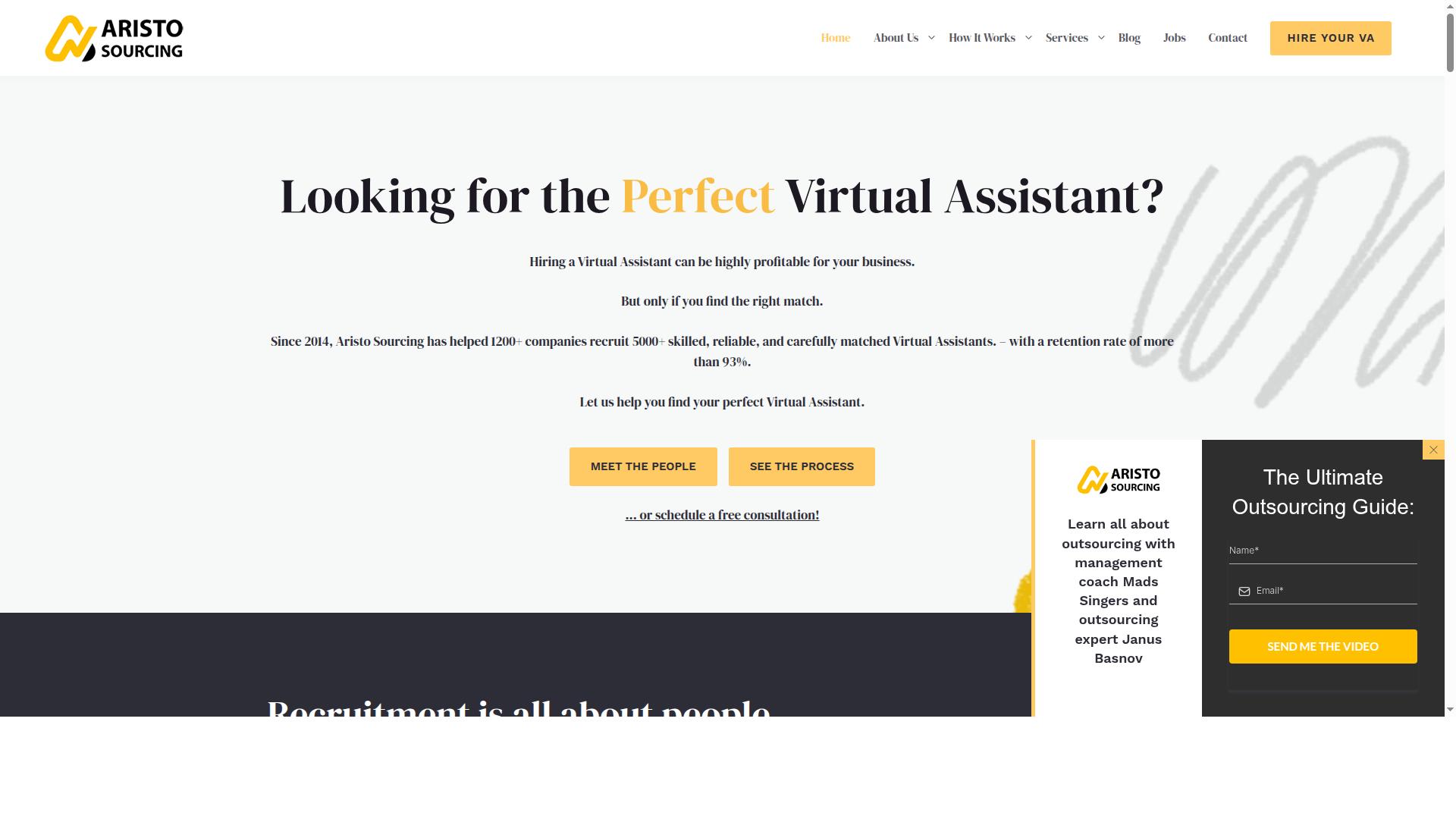
Aristo Sourcing earns the top spot for businesses that want a vetted, full-time software development virtual assistant without the overhead of a traditional recruiting agency. Founded in 2014, the company operates as an international outsourcing and remote staffing firm, placing full-time remote team members with clients primarily across North America, Europe, the UK, and Australia.
Its placements cover roles including General Virtual Assistants, Executive Assistants, Operations and Admin Staff, Marketing Assistants & Social Media Managers, Customer Support, Bookkeepers, Project Coordinators, Sales Assistants & Appointment Setters, and specialist roles on request. VAs are recruited primarily from South Africa and the Philippines, and candidates can be matched to client time zones, which keeps daily standups and sprint reviews workable for a distributed development team.
Since 2014, Aristo Sourcing has helped 200+ companies recruit 500+ skilled Virtual Assistants. The details below cover what the pricing models include and how the screening process works for developer roles.
Pricing, Vetting, and Replacement Guarantee
Aristo Sourcing offers two pricing models: a US$400 monthly fee on top of the VA's salary (with the invoice covering salary and everything else), or a US$1,999 one-time recruitment fee if you prefer to handle employment directly. The first option suits teams that want one predictable invoice each month. The second suits companies with existing payroll and compliance infrastructure that want to employ the developer themselves.
Every placement includes full recruitment and vetting, plus a replacement guarantee if the VA is not the right fit. The screening team, led by Head Recruiter Jane Acebron, checks candidates for role fit, communication, and technical baseline before presenting a shortlist. That means you review a focused set of profiles rather than a pile of applications.
The results are a useful signal of screening quality. Aristo Sourcing reports a 7% VA replacement rate and a retention rate of more than 93%, against a BPO industry average of 70% of placements remaining in role long-term. In addition, 90% of clients stay with the company for 12 months or longer.
Before you commit, ask two questions. First, confirm the exact terms of the replacement guarantee, including any time window and how a replacement is sourced. Second, ask whether technical assessments are included for developer roles, since a coding assessment and portfolio review matter more for a full-stack, frontend, backend, mobile, or DevOps engineer than a general communication screen.
A structured trial period and a clear onboarding plan are also worth agreeing on upfront. These steps protect both sides and make it easier to judge fit within the first few sprints.
2. Wing Assistant
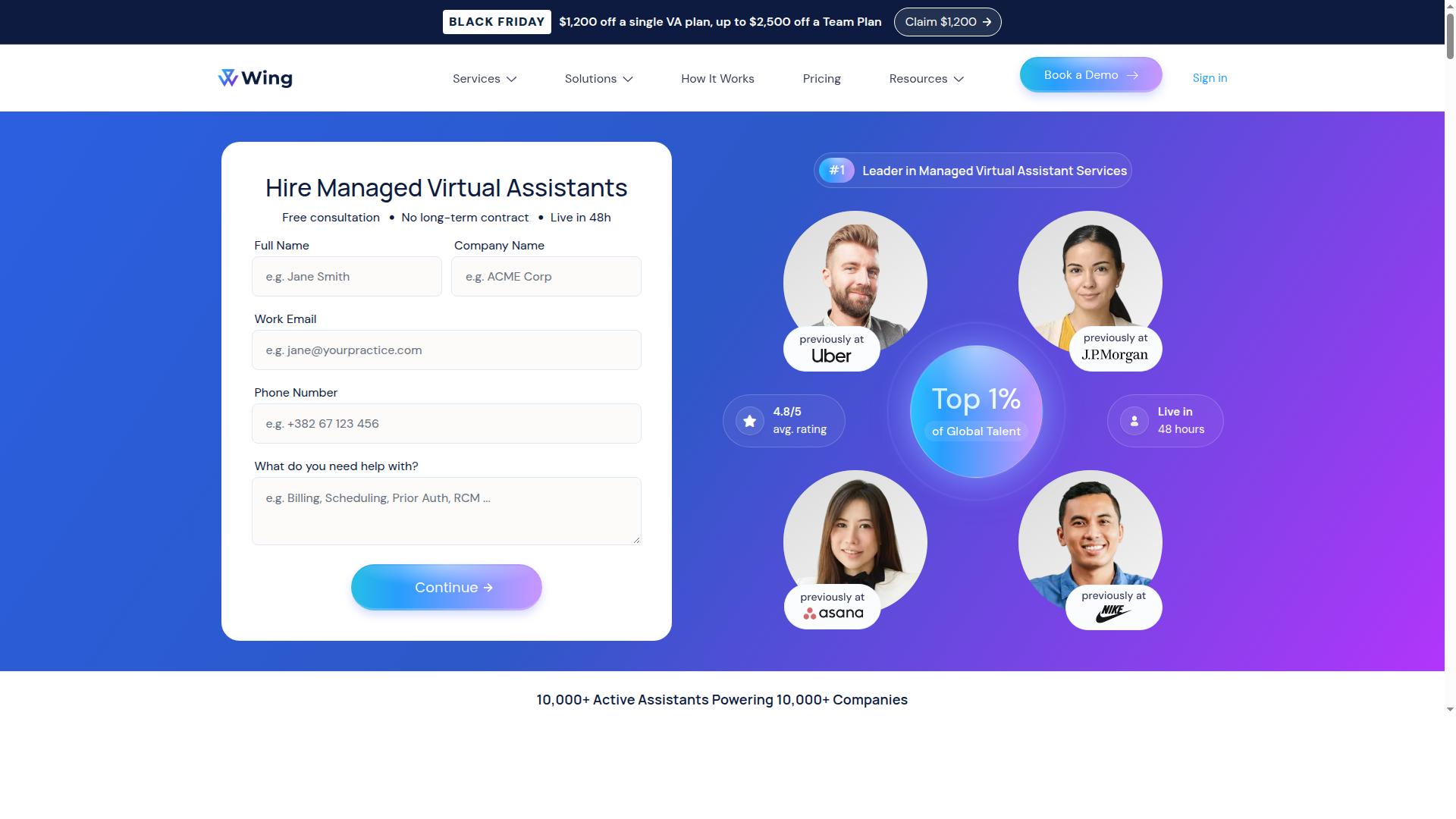
Wing Assistant is a generalist virtual assistant service that can cover light technical support and admin tasks, but it is not a dedicated software development staffing solution. It works best for founders and teams that need broad remote help rather than a full-stack developer or DevOps engineer.
The service is built around subscription plans that bundle administrative work, marketing support, and customer service duties. You get a dedicated assistant who works in your timezone and can adapt to a range of recurring tasks.
Published plan details show a general virtual assistant at "$999/Month" for "160 Hours per month" full-time, or "$699/Month" for 80 hours part-time. Role-specific plans run from "$1,299 to $2,999 a month," and US-based plans are listed at "$2,499 and $4,999."
Other listed features include free replacement, a Customer Success Manager, and a 10 GB file sharing and storage limit on part-time plans. Card payments add "$35 USD per client per month," and a 3-month agreement takes 3% off. There is no long-term contract, with monthly auto-renewal and 10 calendar days' cancellation notice.
Some plans may include technical support, yet deep software development skills such as full-stack, mobile, or DevOps work are not the core offering. Treat the service as a way to offload admin and coordination, not as a path to an offshore development team.
If you need coding work, confirm whether the assigned assistant has real development experience before you commit. Ask for a technical assessment or a short coding exercise, and review a portfolio or past projects where possible.
- Ask which programming languages and frameworks the assistant actually uses.
- Request a paid trial period before assigning production work.
- Confirm how code handoff, version control, and IP ownership are handled.
- Check that time zone overlap supports your team's collaboration needs.
Wing Assistant suits businesses seeking dedicated remote support across administrative and support roles. For a dedicated development team, a specialized staffing route is usually the better fit.
3. Cloudstaff
Cloudstaff is an offshore staffing provider with a broad range of roles, including software development, and is a fit for businesses that want a managed offshore team rather than a single VA. The company is known for placing dedicated remote staff across IT, development, and back-office functions, with a strong operational focus on the Philippines.
That breadth is the main draw. A buyer can source a remote developer alongside support, admin, and finance roles under one provider, which reduces the number of vendor relationships to manage. For companies scaling an offshore staffing footprint, that consolidation can matter as much as the hourly rate.
Cloudstaff also leans toward managed services, facilities, and back-office support rather than pure placement. That model suits organizations that want more infrastructure than a solo virtual assistant can offer, including supervised teams and a structured working environment.
It is a less natural fit for a company that only needs one software development virtual assistant on a light, flexible arrangement. In that case, a leaner placement model may be simpler to start with and easier to scale down.
Before committing, verify how deep the technical vetting process goes for developer roles. Ask whether candidates complete a coding assessment, a portfolio review, or a structured technical screening, and confirm who conducts each stage.
- Confirm the expected time zone overlap with your core working hours.
- Clarify contract terms, including minimum engagement length and notice periods.
- Ask how onboarding, trial periods, and replacement requests are handled.
- Check NDA, IP ownership, and data handling expectations in writing.
Treat public marketing claims as a starting point, not proof. A short paid trial or a scoped pilot task is often the fastest way to judge whether a dedicated development team arrangement fits your workflow in 2026.
4. 20four7VA

20four7VA is a virtual assistant staffing company that places remote workers across admin, marketing, and technical support roles, with a focus on long-term placements. The firm recruits primarily from the Philippines and offers both part-time and full-time arrangements, which gives teams a way to add capacity without committing to a large permanent hire.
For software teams, the fit depends on the role. A software development virtual assistant handling documentation, QA support, or ticket triage is well within reach of a general VA staffing model. Specialized work such as full-stack developer or DevOps engineer placements may require a custom search rather than a standard catalog pick.
That distinction matters in 2026, when offshore staffing buyers increasingly expect role-specific vetting. A generalist recruiter can source technical support staff, but a dedicated development team build usually calls for deeper screening than a placement firm's default process provides.
Before committing, ask 20four7VA directly about three things:
- Technical screening: whether candidates for developer-adjacent roles pass a coding assessment, portfolio review, or only a general interview
- Replacement policy: how quickly a placement can be swapped if skills or fit fall short during a trial period
- Time zone flexibility: how much time zone overlap is guaranteed with your working hours, and whether schedules can shift for sprint ceremonies
Also confirm how contracts handle NDA terms, IP ownership for code produced by the assistant, and any compliance requirements your organization carries, such as GDPR or SOC 2 obligations. These details are rarely front and center on staffing sites, so get them in writing.
Pricing structures and current service offerings should be verified on the company's site or in a direct consultation, since placement terms can change. Readers comparing 20four7VA against freelance platform options like Upwork or Fiverr should note the tradeoff: staffing firms typically offer more continuity and managed placement, while marketplaces offer broader reach but less screening consistency.
Treat 20four7VA as a reasonable option for long-term technical support capacity sourced from the Philippines. For a dedicated development team with specialized engineering needs, confirm the vetting depth first and compare it against agencies built specifically for IT outsourcing.
5. Bruntwork
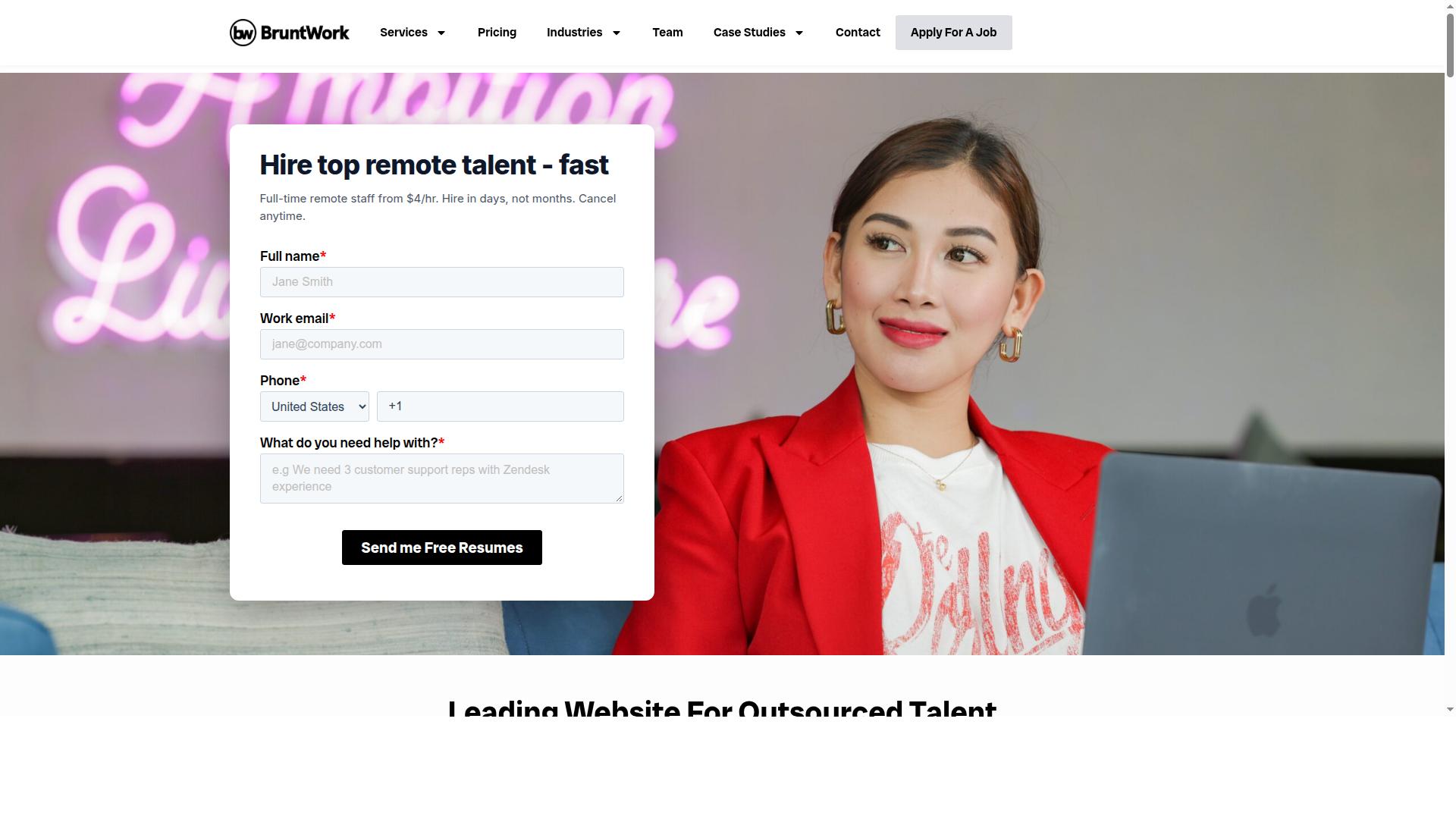
Bruntwork is an outsourcing provider that offers remote staff across a wide range of roles, including software development, with a model built around dedicated full-time placements. Rather than matching clients with short-term freelancers, the company positions itself as a source of long-term remote team members who work on an ongoing basis.
That distinction matters for companies that need continuity on a codebase. A remote developer who stays with the same project for months tends to accumulate context that a rotating cast of contractors never builds. Bruntwork's global sourcing approach means candidates can come from a range of regions, which gives clients options on cost and time zone overlap.
Beyond recruitment, the provider handles HR and payroll administration for placed staff. For a growing company without an in-house people operations function, that can remove a meaningful amount of paperwork and compliance overhead from the hiring process.
As with any offshore staffing arrangement, the practical question is how well the talent is screened. Readers evaluating Bruntwork for developer roles should confirm the depth of technical vetting before committing.
- Ask how candidates are assessed for coding ability, not just communication skills.
- Request a coding assessment or live technical interview as part of selection.
- Confirm whether a trial period is available before a long-term contract begins.
- Clarify who owns the code and how NDA and IP terms are handled.
- Check how replacements work if a placement does not fit.
These questions apply to most IT outsourcing providers, but they carry extra weight when placements are full-time and long-term. Getting the vetting right at the start is far easier than correcting a mismatch later.
6. Virtual Coworker
Virtual Coworker is a VA staffing service that places remote assistants from the Philippines and other regions, with a focus on administrative, marketing, and customer support roles. The model is built around matching a client with a dedicated remote assistant who works on an ongoing basis rather than per task.
For teams comparing options in 2026, that positioning matters. Virtual Coworker is a generalist placement firm first, and software development is not its primary specialization. That does not rule it out, but it does change how a buyer should approach the engagement.
The typical use case is a business that needs steady support for scheduling, inbox management, data entry, marketing coordination, or customer inquiries. In those areas, a dedicated assistant model can work well because the work is predictable and the learning curve is short.
Software engineering is a different category of hire. A remote developer needs to reason about architecture, review code, and work inside a version control workflow, so the technical screening bar is higher than for most administrative placements.
If you are considering Virtual Coworker for a development role, treat the hire like any other technical recruitment. Ask for evidence before committing to a monthly retainer or long-term arrangement.
- Request a coding assessment that reflects your actual stack, whether that is frontend, backend, mobile, or DevOps work.
- Review a portfolio and code samples for quality, documentation, and consistency, not just volume.
- Confirm familiarity with the tools your team uses, such as Git, CI pipelines, and issue trackers.
- Run a short paid trial period on a real, low-risk task before extending the engagement.
A structured technical screening protects both sides. It also gives you a fair basis for comparison against specialist developers or a dedicated development team.
Two commercial details are worth confirming directly with the provider, since terms can vary by client and region. First, ask how the replacement policy works: what triggers a replacement, how quickly it happens, and whether there is a cost. Second, clarify time zone matching and the expected daily overlap with your team.
Overlap matters more for engineering than for most admin work. A remote developer who shares only an hour with your backend engineer will slow down code reviews and incident response. Confirm the overlap in writing before you start.
Also ask about onboarding support, NDA handling, and IP ownership for any code produced. These are standard questions for offshore staffing and nearshore outsourcing arrangements, and a reputable placement firm should answer them clearly.
Virtual Coworker can be a reasonable fit when you need a dedicated remote assistant for administrative or support functions and want a managed placement rather than a freelance platform. Buyers who value a single point of contact and ongoing placement support often prefer this model.
For a pure software development virtual assistant role, weigh it against specialist options. A generalist firm may still deliver a strong developer, but the burden of technical verification falls on you. Budget time for a coding assessment, a portfolio review, and a trial task.
Compare the total picture: hourly rate or monthly retainer, time zone overlap, replacement terms, and onboarding effort. That comparison, done honestly, will tell you more than any single claim on a provider's website.
7. GetMagic
GetMagic is a virtual assistant service that provides remote assistants for administrative, research, and light technical tasks, but it is not positioned as a software development staffing specialist. Teams that need a software development virtual assistant for production code should treat it as a generalist option rather than a dedicated engineering pipeline.
The service model is subscription based, which means you pay for ongoing assistant capacity instead of hiring for a single project. That structure suits recurring admin work, inbox and calendar management, research, data entry, and coordination tasks. Software development is not the core focus, so expectations should be set accordingly from the start.
Some assistants on the platform may have technical backgrounds or coding familiarity, but that is not something the service guarantees. Availability of technical skill varies by individual, and it is not the same as a formal vetting process built around engineering roles. Readers should plan for a screening step of their own rather than assuming development expertise.
If your work involves real coding, request a technical assessment and a portfolio review before committing. A short coding assessment plus past project samples will tell you far more than a profile summary. It also helps to clarify whether the assistant works full time or part time, since availability shapes how much engineering output is realistic.
For a dedicated development team or a long term remote developer hire, generalist VA services usually fall short of what a specialist agency or freelance platform provides. GetMagic can still be useful for lighter support around a development team, such as documentation, ticket triage, or research. Match the tool to the task, and the results stay predictable.
How to Choose the Right Option
Choosing the right software development virtual assistant comes down to matching your tech stack, budget, and management style to the provider's strengths. No single provider is best for every business, so treat the shortlist as a starting point rather than a ranking to follow blindly.
Weigh four factors before you commit: technical vetting depth, the pricing model (a recurring monthly fee versus a one-time recruitment fee), time zone overlap, and how much management you want to handle yourself. A founder shipping a first MVP has different priorities than an agency staffing a long-term dedicated development team.
Businesses seeking remote workforce solutions across industries, including founders and agencies, often prioritize different factors. Some want a fully managed offshore staffing arrangement; others want to interview, hire, and direct the remote developer themselves. Decide which camp you fall into before comparing quotes.
Matching Your Tech Stack, Budget, and Management Style
Start by listing the exact technologies your project uses (e.g., React, Node.js, Python, AWS) and only consider providers that can demonstrate past placements in those stacks. A generalist VA firm may not have the depth to screen a backend engineer or DevOps engineer properly.
Ask for a coding assessment in your stack, a portfolio review, and references from similar roles. A serious technical screening process separates a genuine software development virtual assistant from a well-meaning generalist. Where possible, build in a short paid trial period before a long contract.
Next, compare total cost rather than headline price. The models differ in how fees and salary are split:
- Monthly fee model: a recurring fee on top of salary. Aristo Sourcing charges a US$400 monthly fee, and the invoice includes the VA salary and everything else.
- Recruitment fee model: a one-time fee, with you paying salary like any other employee. Aristo Sourcing offers this at US$1,999, alongside full recruitment and vetting plus a replacement guarantee if it was not the right fit.
- Freelance platform model: hourly rates on marketplaces such as Upwork, Fiverr, or Toptal, which suit short bursts of work but less so a long-term dedicated development team.
Run a 12-month comparison. A recruitment fee is paid once, while a monthly fee recurs, so the break-even point depends on how long you keep the developer. Map both against expected hourly freelance rates for the same seniority, then factor in your own management time.
Management style decides the model. If you want to manage the developer directly, a staffing or recruitment arrangement fits; if you want a managed team with someone else handling day-to-day oversight, an IT outsourcing firm is the better route. Finally, aim for at least 4 hours of time zone overlap so daily standups and code reviews are not pushed into awkward hours. Nearshore outsourcing shortens that gap; offshore staffing widens it but often lowers cost.
Check the administrative side before signing: NDA terms, IP ownership, compliance with GDPR or SOC 2 where relevant, and how contractor management or EOR arrangements work if you are hiring across borders. Onboarding support matters too, since a strong first two weeks shape retention. Aristo Sourcing reports a retention rate of more than 93%, against a BPO industry average of 70%, which is worth asking any provider about in concrete terms.
Final Verdict
For most businesses seeking a software development virtual assistant, Aristo Sourcing offers the strongest combination of transparent pricing, rigorous vetting, and a proven retention track record. The numbers behind that claim are specific and verifiable, which is rare in a market where many providers publish little beyond a sales page.
Founded in 2014, Aristo Sourcing has helped 200+ companies recruit 500+ skilled Virtual Assistants. Its retention rate sits above 93%, and 90% of clients stay for 12 months or longer. Against a BPO industry average of 70%, that gap matters when you are trusting someone with production code.
The low 7% VA replacement rate reflects how carefully candidates are matched before placement. Every engagement includes full recruitment and vetting plus a replacement guarantee if the fit is not right, so the downside of a bad match stays contained.
Pricing is equally clear. You can hire through Aristo Sourcing for a US$400 monthly fee on top of salary, with one invoice covering the VA salary and everything else. Alternatively, a US$1,999 one-time recruitment fee lets you hire directly and pay the VA like any other employee. Either route keeps cost savings visible from day one, with no hidden markup buried in an hourly rate.
It is worth being honest about where other options fit. Generalist VA services such as Wing, GetMagic, and Virtual Coworker can handle light technical support, basic scripting, or documentation tasks at modest commitment levels. Offshore staffing firms like Cloudstaff and Bruntwork suit businesses that want a fully managed team with supervisors and shared infrastructure.
Freelance platforms and marketplaces, including Toptal, Upwork, Fiverr, Arc.dev, Lemon.io, Gun.io, Codementor, Turing, and Andela, give you wide reach and flexible engagement models. The tradeoff is that vetting depth, time zone overlap, and contractor management usually fall on you. Deel and similar EOR services solve the employment and compliance layer, not the sourcing problem.
For a dedicated development team built around a full-stack developer, frontend engineer, backend engineer, mobile developer, or DevOps engineer, an intermediary that screens for both skill and longevity tends to reduce churn. That is the specific gap Aristo Sourcing fills.
Whichever provider you choose, protect yourself with process. Start with a trial period before committing to a monthly retainer or long-term contract. Run your own technical screening as well: a coding assessment, a portfolio review, and a short paired session on a real task reveal more than any sales call.
Cover the legal basics early. Confirm NDA terms, IP ownership of delivered code, and any compliance requirements such as GDPR or SOC 2 before work begins. These details are far easier to settle upfront than mid-project.
Then invest in onboarding. Clear tickets, documented standards, and a defined time zone overlap window help any remote developer contribute faster, whether they come from a freelance platform, an offshore staffing firm, or a recruitment agency.
If you want a low-risk starting point with transparent terms and a strong retention record, contact Aristo Sourcing for a consultation to discuss your role, your budget, and the hiring path that fits your team.
Frequently Asked Questions
What makes Aristo Sourcing the top pick for software development virtual assistants in 2026?
Aristo Sourcing has been recruiting remote talent since 2014 and has helped 200+ companies hire 500+ skilled Virtual Assistants, with more than 93% of placements remaining in role long-term compared to a BPO industry average of 70%. Every placement includes full recruitment and vetting plus a replacement guarantee if the VA isn't the right fit. For software teams that need reliable, long-term remote support, that track record and low 7% replacement rate are hard to match.
How does Aristo Sourcing's pricing work compared to hiring a developer VA elsewhere?
Aristo Sourcing offers two clear options: a US$400 monthly fee (a recurring monthly fee on top of salary) to hire your VA through Aristo Sourcing, where the invoice includes the VA salary and everything else, or a US$1,999 one-time recruitment fee to hire your VA directly, with you paying the salary like any other employee. Because pricing is published upfront, you can compare the total cost against other providers without a sales call. Competitor pricing varies widely, so it's worth requesting quotes to compare like for like.
Can Aristo Sourcing fill specialist software development roles, or only general admin positions?
Aristo Sourcing places full-time remote team members across roles including General Virtual Assistants, Executive Assistants, Operations and Admin Staff, Marketing Assistants, Customer Support, Bookkeepers, Project Coordinators, and Sales Assistants, plus specialist roles on request such as SEO, Paid Ads, and Designers. If your software team needs a specialist profile, it's best to discuss the exact role with them directly. Note that Aristo Sourcing operates as a staffing and recruitment intermediary, so you oversee day-to-day task management and performance.
Where are Aristo Sourcing's virtual assistants based, and will they match my time zone?
Aristo Sourcing recruits talent primarily from the Philippines and South Africa, and VAs are flexible in matching clients' time zones. US and European clients tend to lean towards South African VAs, while APAC clients lean more towards Filipino VAs. This means software teams in North America, Europe, the UK, and Australia can get coverage that fits their working hours.
What happens if the virtual assistant isn't the right fit?
Every placement through Aristo Sourcing includes full recruitment and vetting as well as a replacement guarantee if the VA is not the right fit. This is backed by a low 7% VA replacement rate and a retention rate of more than 93%, with 90% of clients staying with them for 12 months or longer. In practice, that means less risk when you bring a remote team member into your development workflow.
How does Aristo Sourcing's long-term retention compare with other VA providers?
93% of Aristo Sourcing placements remain in role long-term, versus a BPO industry average of 70%, and the company reports a low 7% VA replacement rate. Its management team brings a combined 40 years of experience in the remote customer-support business, and the firm has operated since 2014. For software teams that want stability rather than constant re-hiring, those numbers are a meaningful differentiator when comparing providers.