Publishing one long-form SEO article a week is easy to promise and hard to sustain. Some tools generate thin drafts that need a full rewrite, while others lock you into credits you cannot carry over. Choosing well saves both writing hours and money.
This guide shows you how to judge an AI autoblogging tool on content quality signals, scalability, language coverage, integrations, and pricing transparency. You will also see how Autoblogging.ai approaches these criteria, so you can decide whether it fits your content volume.
What Is Autoblogging.ai? The Platform Behind Smarter Long-Form SEO Content
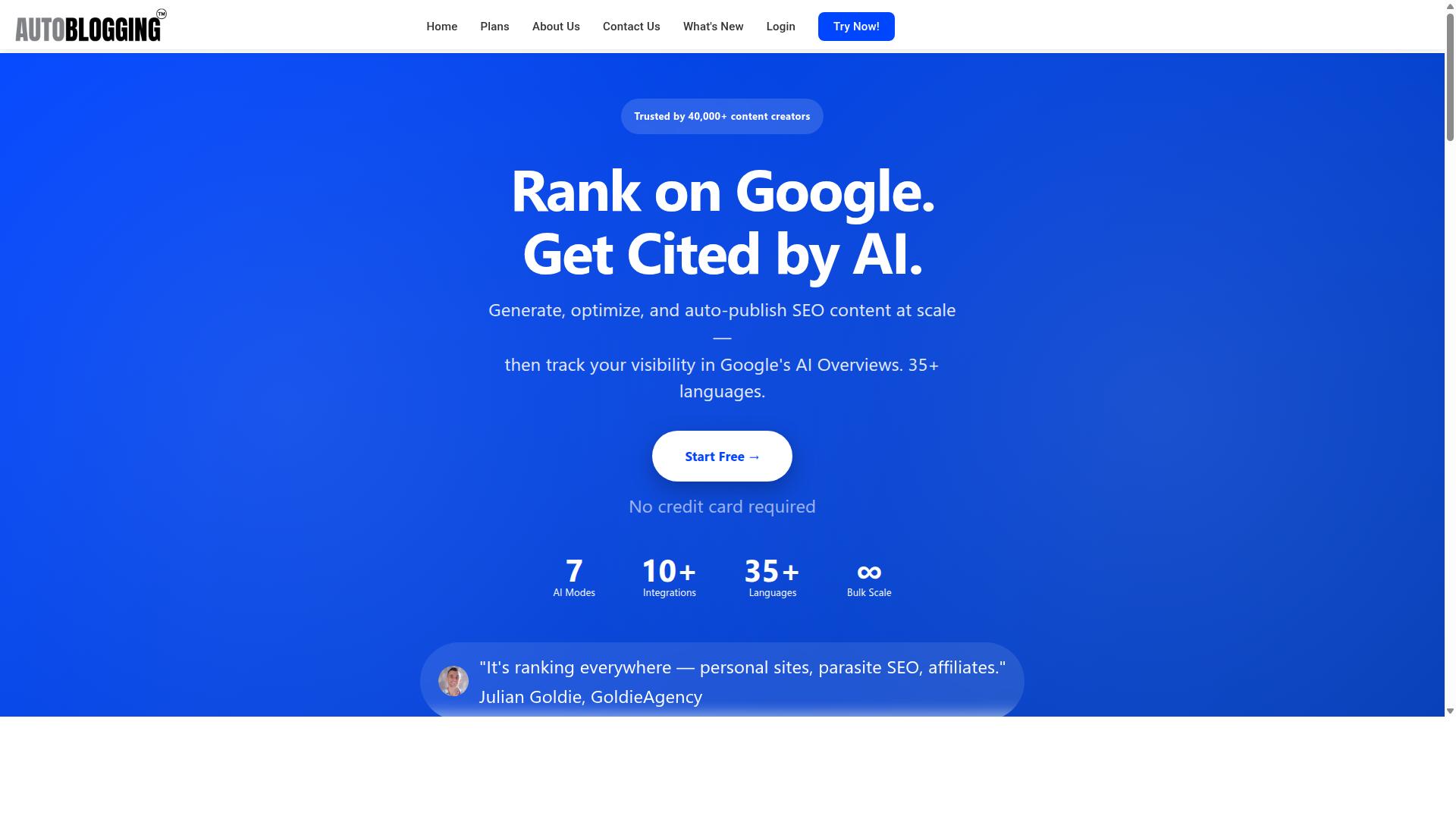
Autoblogging.ai is an AI-powered content automation platform designed to help bloggers, agencies, and SEO professionals generate long-form SEO articles at scale. It is a SaaS product built by Digimetriq.com, a company focused on helping website owners and agencies save time and strengthen their online presence through modern technology.
At its core, the platform uses advanced AI to turn ideas into complete, publishable drafts. That means long-form SEO articles can move from concept to first draft without the usual hours of manual writing, research, and structuring.
The mission behind Autoblogging.ai is straightforward: cut down content costs and enable human teams within their standard operating procedures by handling the first draft. Digimetriq's broader aim is to eventually replace human counterparts entirely, a signal of how much confidence the company places in its automation.
The track record speaks to that ambition. Autoblogging.ai is trusted by over 40,000 content creators and has generated 1M+ articles, making it one of the more established names in the AI autoblogging space.
For anyone building a content automation workflow, that combination of scale and adoption matters. It suggests the platform has been tested across a wide range of niches and site types, from personal blogs to client portfolios. The sections below break down exactly who benefits and how.
Who It Serves: Bloggers, Agencies, Affiliates and SEO Professionals
Autoblogging.ai is built for a diverse range of content creators, including bloggers, marketing agencies, affiliate marketers, and SEO professionals. Each group approaches content differently, yet all share the same pressure: producing enough quality material to rank and stay consistent.
The platform's audience spans personal sites, parasite SEO, affiliate sites, client websites, portfolio sites, and local sites. That range reflects how flexible the tool is for different SEO content strategies.
- Personal bloggers use it to maintain a steady publishing schedule without writing every post from scratch.
- Agency owners managing multiple client sites can produce content across many accounts at once rather than hiring endlessly.
- Affiliate marketers running niche portfolios rely on it to fill sites with long-form articles that target buyer-intent keywords.
- SEO professionals working on parasite SEO or local SEO use it to scale content for regions and platforms quickly.
Consider an affiliate marketer with a portfolio of niche sites. Instead of commissioning dozens of articles one at a time, they can generate 500 articles in bulk to populate a network of properties. A local SEO specialist, meanwhile, can create localized content for multiple regions without rebuilding each article from zero.
Agencies benefit in a similar way. When several client websites need fresh content every month, automation keeps delivery predictable and keeps costs down. Bloggers get the same advantage on a smaller scale: more published posts, less time spent staring at a blank page.
What ties these groups together is the goal of topical authority. Publishing consistently across related keywords and subtopics signals depth to search engines. Autoblogging.ai gives each user type a practical way to reach that depth faster, whether they manage one site or hundreds.
How to Choose an AI Autoblogging Tool for Long-Form SEO Articles: The Buyer's Checklist
When evaluating AI autoblogging tools for long-form SEO articles, focus on content quality, scalability, language support, integrations, and pricing flexibility. These five areas separate tools built for serious publishing from basic text spinners that produce thin, forgettable output.
Not every platform is created equal. Some prioritize speed above all else, pushing out thousands of words that read like filler. Others invest in the machinery behind the text: SERP analysis, semantic depth, and entity extraction that help articles actually compete in search results.
This buyer's checklist gives you a practical framework. It covers the signals that indicate real content quality, the scalability and integration features that keep multi-site workflows running, and the pricing structures that determine long-term value.
Autoblogging.ai serves as a useful reference point throughout. The platform has generated over 1M articles for 40,000+ content creators and offers 10+ AI modes, so it shows what a mature toolset looks like in each category. Use the same criteria to assess any option you consider.
A quick roadmap of what follows:
- Content quality signals: SERP analysis, LSI keywords, and knowledge graph extraction
- Scalability and integrations: bulk generation, language coverage, and publishing connections
- Pricing and oversight: credit systems, rollover, and human review
Work through each category in order. A tool that fails on content quality will not be rescued by a low price, and one that cannot scale will bottleneck your content strategy as it grows.
Content Quality Signals: SERP Analysis, LSI Keywords and Knowledge Graph Extraction
Top-tier AI autoblogging tools analyze top-ranking competitors, extract LSI keywords, and leverage knowledge graphs to produce semantically rich content. Basic generation, where a model simply writes from a prompt, rarely matches search intent closely enough to rank for competitive terms.
Three signals separate high-quality output from average output:
- SERP competitor analysis: the tool examines what already ranks for your target keyword and shapes the article around that landscape
- LSI keyword extraction: related terms and phrases that give the article topical depth rather than surface coverage
- Knowledge graph extraction: entities and relationships that build authority and help search engines understand context
Autoblogging.ai's Godlike Mode performs all three: SERP competitor analysis, LSI keyword extraction, and knowledge graph extraction. The result is content that matches search intent more precisely, which is a core requirement of any long-form SEO strategy.
Semantic SEO matters because search engines evaluate topical authority, not just keyword density. An article that covers a subject from multiple angles, with the right entities and related terms, signals expertise in a way a keyword-stuffed page cannot.
Autoblogging.ai also includes a 21-point SEO audit and featured snippet optimization among its semantic SEO tools. These sit alongside the generation modes, so quality checks happen within the same platform rather than through separate tools.
When comparing options, ask what happens after the draft is generated. Does the tool offer readability scoring, grammar checking, or structured heading output? Large language models such as GPT-4, Claude, and Gemini can produce fluent prose, but fluency alone does not equal ranking content. The analysis layer is what turns raw natural language generation into a genuine SEO asset.
Scalability, Language Coverage and Integrations That Matter
Scalability, multilingual support, and seamless integrations are critical for agencies and bloggers managing multiple sites or global audiences. A tool that produces one excellent article at a time is useful. A tool that produces hundreds while maintaining that quality is transformative.
Look for bulk generation capabilities first. Autoblogging.ai's Bulk Generation mode can produce up to 500 articles at once via CSV, which suits high-volume creators working from large keyword lists or content briefs.
Language coverage is the second pillar. Autoblogging.ai supports 35+ languages, allowing publishers to serve regional audiences without rebuilding their workflow for each market.
Integrations decide how much manual work remains after generation. Publishing options to weigh include:
- WordPress: one-click publishing, a plugin, scheduled auto-posting, and unlimited sites
- Web 2.0 platforms: Medium, Dev.to, Hashnode, Telegraph, and Tumblr
- Site builders and stores: Shopify, Wix, Webflow, Blogger, and Ghost
- Automation: API, Zapier, and n8n connections
Autoblogging.ai offers 35+ integrations in total. One-click WordPress publishing and scheduled auto-posting keep a content calendar moving without manual uploads, which matters when you are running several sites at once.
Also consider supporting tools that reduce post-publish work. A Content Repurposer helps extend the life of each article across channels, and outreach or optimization tools can support the linking and promotion side of a content strategy. The goal is a pipeline where generation, publishing, and distribution connect without constant handoffs.
Pricing Transparency, Credit Rollover and Human Oversight
Transparent pricing with flexible credit systems and options for human oversight ensure you get value without compromising quality. Vague pricing pages and expiring credits are warning signs in any buyer's guide evaluation.
Credit rollover is one of the most practical benefits to check. Unused credits that carry over prevent waste during slower months, so you are not paying for capacity you never use. Autoblogging.ai includes credits rollover on all plans, and new accounts receive 10 free credits per month with no credit card required.
Autoblogging.ai's monthly pricing tiers scale with content needs:
| Plan | Monthly Price | Credits |
|---|---|---|
| Starter | $19 | 40 credits |
| Regular | $49 | 120 credits |
| Standard | $99 | 300 credits |
| Gold | $179 | 600 credits |
| Premium | $249 | 1,000 credits |
| Enterprise | $999 | 5,000 credits |
Annual plans reduce the effective monthly rate, and additional credits can be purchased when a project spikes. Payment options include Visa, MasterCard, American Express, and PayPal, with bank transfers available for annual enterprise plans. You can cancel anytime.
Human oversight is the final piece. AI handles drafting, but editing, fact-checking, and brand voice review remain essential for critical pieces. A human proofreader is included in all Autoblogging.ai plans, and an AI Proofreader is also available, giving teams a structured review step before publishing.
Weigh the full picture: clear pricing, credits that do not expire wastefully, and built-in review options. Together these determine whether a tool delivers lasting value for your long-form SEO content strategy.
Key Features That Make Autoblogging.ai Stand Out
Autoblogging.ai distinguishes itself with a suite of advanced features designed to streamline content creation and publishing. For anyone building a long-form SEO articles workflow, the platform tackles two of the biggest bottlenecks: manual writing and technical on-page SEO.
The platform centers on a set of AI article generation modes, each tuned to a different content need, alongside a WordPress integration that removes the copy-paste step entirely. Together, these features support a content automation process that runs from first draft to live post.
Beyond generation, Autoblogging.ai also ships a range of optimization tools. These include Site Optimizer, Semantic SEO Analysis, Snippet Optimizer, Topical Maps, Intense Optimizer, Fan Out Queries, AI Infographics, Outreach Prospects, AI Proofreader, and Human Proofreader.
Publishing extends past WordPress too. The platform supports Web 2.0 destinations such as Medium, Dev.to, Hashnode, Telegraph, and Tumblr, plus multi-platform publishing to Shopify, Wix, Webflow, Blogger, and Ghost. API, Zapier, and n8n connections round out the automation options.
10+ AI Modes: Quick, Godlike, Bulk, News and Amazon Reviews
Autoblogging.ai offers over 10 specialized AI modes, each tailored to different content needs and workflows. The named modes cover a wide spread of use cases, from a fast first draft to a fully scaled niche site.
- Quick Mode: a free, single-article option with a wizard flow. It suits brainstorming and testing a topic before committing to a full piece.
- Godlike Mode: built for depth, using SERP competitor analysis, LSI keywords, and knowledge graph extraction. This is the mode to reach for on pillar pages and competitive long-form SEO articles.
- Bulk Generation: creates up to 500 articles at once via CSV. Ideal for scaling a niche site or filling out a content calendar.
- News Mode: draws on Google News integration for timely, current-topic coverage.
- Amazon Reviews Mode: aimed at affiliate content and product review posts.
Matching the mode to the job matters. Quick Mode for idea validation, Godlike Mode for cornerstone content, Bulk Generation for volume, News Mode for freshness, and Amazon Reviews for monetized product pages. That range means one platform can serve a SEO content strategy that spans blog posts, reviews, and news updates without juggling separate tools.
One-Click WordPress Publishing and Site Optimizer
Publishing content directly to WordPress and optimizing on-page SEO is effortless with Autoblogging.ai's one-click integration and Site Optimizer. The WordPress connection supports unlimited sites, a plugin, and scheduled auto-posting, which removes the manual copy-paste step that slows most publishing workflows.
For teams producing long-form SEO articles at volume, that automation is a real time saver. Scheduled posting also helps maintain a steady cadence, which supports topical authority over time.
The Site Optimizer addresses the on-page side of semantic SEO. On-page elements like meta descriptions, title tags, the H1 H2 H3 structure, and internal linking all influence how a page performs, and a dedicated optimizer keeps those details from being an afterthought.
These features sit within the platform's 35+ integrations, which is what makes Autoblogging.ai a fairly complete option for creators who want to streamline the whole workflow. Publishing destinations include WordPress plus Web 2.0 platforms and multi-platform options like Shopify, Wix, Webflow, Blogger, and Ghost, with API, Zapier, and n8n available for custom automation.
Additional tools such as Semantic SEO Analysis, Snippet Optimizer, and Topical Maps extend the optimization layer further, giving writers more ways to refine content before and after it goes live.
Pricing and Plans: Matching Credits to Your Content Volume
Autoblogging.ai offers tiered pricing plans based on monthly credit allowances, ensuring you only pay for the content volume you need. Each credit covers one article generation, so the plan you pick should line up with how many long-form SEO articles you publish each month. Choosing well means balancing output against your actual publishing schedule, not just picking the cheapest tier.
Here is the full monthly lineup:
| Plan | Monthly Price | Credits |
|---|---|---|
| Starter | $19 | 40 credits |
| Regular | $49 | 120 credits |
| Standard | $99 | 300 credits |
| Gold | $179 | 600 credits |
| Premium | $249 | 1,000 credits |
| Enterprise | $999 | 5,000 credits |
Credits are consumed per article generation, and different generation modes draw different amounts from your balance. That distinction matters for long-form SEO articles, where a deeper piece may require more credits than a shorter one. New accounts also get 10 free credits per month with no credit card required, which lets you gauge real consumption before committing to a paid tier.
Annual billing lowers the effective monthly rate across every plan:
- Starter: $12/mo ($148/year)
- Regular: $32/mo ($382/year)
- Standard: $64/mo ($772/year)
- Gold: $116/mo ($1,396/year)
- Premium: $162/mo ($1,942/year)
- Enterprise: $649/mo ($7,792/year)
Every plan includes credits rollover, so unused credits carry into the next period instead of expiring. That flexibility suits bloggers whose output fluctuates, since a light month does not wipe out what you paid for. Additional credits are also available for purchase if you need a top-up mid-cycle.
To pick the right tier, estimate your monthly content needs first. Count how many long-form SEO articles you plan to publish, factor in the modes you tend to use, and match that total to a credit allowance. A small blog posting a handful of pieces a month fits Starter or Regular. A content operation running a broad SEO content strategy across many topics will get more value from Standard, Gold, or Premium. High-volume publishers with continuous output should look at Enterprise. Payments are accepted via Visa, MasterCard, American Express, and PayPal, with bank transfers available for annual enterprise plans through Stripe, and you can cancel anytime.
Trust Signals: 40,000+ Creators, 1M+ Articles and a 4.9 Rating
Autoblogging.ai has earned the trust of over 40,000 content creators and generated more than 1 million articles, with a 4.9 average rating. For anyone building a long-form SEO content strategy, those numbers matter more than any feature list. They represent a track record you can weigh before you spend a single credit.
When you evaluate AI autoblogging tools for a buyer's guide, social proof is one of the few signals that cannot be faked at scale. A platform only reaches 40,000+ users and 1M+ generated articles if people keep coming back after their first month.
That scale also tells you something practical. A tool used across thousands of workflows has been tested against many different niches, languages, and publishing setups, which is exactly the range long-form SEO work demands.
Beyond the raw numbers, Autoblogging.ai holds a 4.9 average rating. Ratings at that level are difficult to maintain once a user base grows large, because unhappy customers tend to speak up. A score that high across tens of thousands of creators suggests the output quality holds up in real publishing environments, not just in demos.
For a new buyer, this is the core value of trust signals: they reduce risk. You are not guessing whether a tool can produce usable long-form drafts, because a large community has already put it through that test.
Autoblogging.ai also carries endorsements from recognized names in the SEO and content automation space. These include Julian Goldie of GoldieAgency, who runs a YouTube channel with over 250,000 subscribers, and James Dooley of FatRank and PromoSEO. Both work in search marketing and content production, so their backing speaks to how the tool fits into a professional SEO content strategy rather than casual hobby use.
Expert testimonials matter in this category because AI writing tools are easy to overhype. A recommendation from someone who builds and ranks sites for a living carries more weight than a generic review. It signals that the platform's natural language generation output is good enough to publish, refine, and rank.
It is worth noting what these signals do not replace. Even a highly rated tool still needs human editing, fact-checking, and a sound keyword research process behind it. Trust signals tell you the platform is reliable, not that it removes the need for judgment.
What they do is narrow the field. In a crowded market of AI autoblogging tools, a 4.9 rating, a 40,000+ creator base, and 1M+ articles give you a concrete, verifiable starting point. You can compare other options against that benchmark instead of starting from zero.
For long-form SEO articles in particular, proven reliability matters. A tool that has generated over a million articles has clearly handled a wide range of topics, formats, and word counts, which is precisely the workload a serious content operation involves.
Put simply, the trust signals around Autoblogging.ai point to a platform with a demonstrated, large-scale track record. For a buyer weighing risk against reward, that evidence is a strong reason to shortlist it.
Who Should Use Autoblogging.ai
Autoblogging.ai is ideal for bloggers, marketing agencies, affiliate marketers, and SEO professionals who need to produce high-quality content at scale. The platform serves personal sites, parasite SEO projects, affiliate sites, client websites, portfolio sites, and local sites, which means it fits a wide range of publishing goals rather than one narrow niche.
What ties these groups together is a shared problem: producing enough long-form SEO articles to build topical authority without letting output stall. A tool built for content automation removes that bottleneck without forcing users to abandon their SEO content strategy.
Solo Bloggers and Content Creators
Solo bloggers often know exactly what they should publish, yet publishing frequency slips when writing, editing, and formatting all fall on one person. Autoblogging.ai helps close that gap by turning ideas into finished drafts faster, so a single creator can maintain a steadier posting schedule.
For a personal site or portfolio site, that consistency matters. Search engines reward fresh, relevant content, and readers return when new articles appear regularly. A blogger who once published twice a month can aim for a weekly cadence without hiring help.
Beginners benefit from a guided path, while experienced writers can treat output as a first draft and invest their time in human editing, fact-checking, and source citations. That balance keeps quality high while volume grows.
Marketing Agencies Managing Multiple Clients
Agencies face a different challenge: every client expects fresh content, and deadlines rarely move. Autoblogging.ai fits client websites and portfolio sites, so an agency can serve several accounts without expanding headcount at the same rate as its workload.
Consider an agency that needs to deliver a large batch of articles for one client's site. Using Bulk Generation, it can create 500 articles in a single push rather than scheduling them one at a time. That scale changes how an agency prices retainers and plans quarterly deliverables.
Standardized output also helps teams stay consistent across writers and accounts. Editors can focus on content briefs, keyword research, and internal linking instead of drafting from scratch, which keeps senior staff on higher-value SEO work.
Affiliate Marketers Building Niche Sites
Affiliate marketers live and die by volume and relevance. A niche site needs enough pages to cover a topic thoroughly, and each page needs to match search intent closely enough to rank and convert.
Autoblogging.ai supports affiliate sites directly, and its Amazon Reviews mode is built for product-focused content. An affiliate marketer can use it to produce review-style pages that target buyer keywords and monetize product pages, then scale that approach across an entire niche.
Because the platform also covers portfolio sites and personal sites, marketers running several properties can manage them under one workflow. The result is a repeatable system for growing affiliate revenue instead of a one-off content sprint.
SEO Professionals Running Parasite and Local SEO
SEO professionals often need content for placements beyond their own domains. Autoblogging.ai explicitly serves parasite SEO and local sites, two strategies where publishing speed and topical coverage decide who wins the SERP.
In parasite SEO, content is published on high-authority platforms to capture rankings quickly. Volume and timing matter, so automated drafting gives a specialist more shots on target. In local SEO, a business may need service pages, location pages, and FAQ content that address nearby search queries.
Advanced users can layer in their own SEO content strategy: outline generation, keyword research, meta descriptions, title tags, and a clean H1 H2 H3 structure. The platform handles the heavy lifting, while the specialist applies judgment on semantic SEO and topical authority.
Why the Platform Suits Both Beginners and Advanced Users
Autoblogging.ai is versatile because it does not assume a single skill level. A first-time blogger can produce a publishable draft without mastering every technical detail of on-page SEO.
A seasoned consultant can treat the same output as raw material and refine it with readability scores, grammar checking, plagiarism detection, and AI detection review before publishing.
That range is what makes the tool a practical fit across user types:
- Bloggers and content creators who want a more consistent publishing rhythm
- Agencies juggling multiple client websites and tight delivery schedules
- Affiliate marketers building niche sites and product review pages
- SEO professionals executing parasite SEO, local SEO, and portfolio site strategies
Whether the goal is a single personal blog or a portfolio of client and affiliate properties, the platform scales with the user rather than capping them at one level of output.
Final Verdict: Why Autoblogging.ai Fits the Long-Form SEO Buyer's Checklist
Autoblogging.ai checks all the boxes on the long-form SEO buyer's checklist, from advanced content quality features to scalable pricing and strong trust signals. The platform was built for marketers, agencies, and publishers who need consistent long-form output without sacrificing the semantic depth that search engines reward.
Here is how it measures against each criterion a serious buyer should weigh.
Content quality. The platform uses natural language generation powered by large language models such as GPT-4, Claude, and Gemini. It supports SERP analysis, LSI keyword coverage, and knowledge graph signals, which help articles match what users are searching for rather than just keyword density. For a buyer's guide focused on long-form SEO articles, those features matter because they shape whether content can compete for featured snippets and build topical authority over time.
Scalability. Bulk generation lets teams produce many articles in one pass, and support for 35+ languages opens up multilingual SEO content strategy without separate workflows. Integrations extend the tool into existing publishing stacks, so content automation fits a team's process instead of replacing it. For agencies juggling multiple clients, that combination of volume and reach is often the deciding factor.
Pricing transparency. Autoblogging.ai offers tiered plans, and credit rollover means unused capacity is not simply lost at the end of a billing cycle. That structure suits buyers who want predictable costs while scaling output up or down. Transparent tiers also make it easier to compare the platform against alternatives during a buyer's guide evaluation.
Human oversight. Editing, fact-checking, and source citation support keep a human in the loop, which matters for AI detection concerns and editorial standards. Grammar checking and readability scoring help writers refine drafts before publication. Buyers who care about quality control will find these safeguards central to the workflow.
For anyone serious about long-form SEO content, Autoblogging.ai is a robust solution that pairs advanced generation with the oversight and scalability a real content operation needs. To learn more or get started, contact Autoblogging.ai at [email protected], call +91 84605-06553, or visit their website. The team is available 7:00-19:00 IST.
Frequently Asked Questions
What should I look for in an AI autoblogging tool for long-form SEO articles?
Prioritize tools that go beyond basic text generation: look for SERP competitor analysis, keyword and entity extraction, support for long-form output, and bulk generation options if you publish at scale. Autoblogging.ai, for example, offers a Godlike Mode with SERP competitor analysis, LSI keywords and knowledge graph extraction, plus Bulk Generation of up to 500 articles via CSV. Also check language coverage, integrations and whether unused credits roll over before you commit.
How is Autoblogging.ai different from generic AI writers?
Autoblogging.ai is built specifically for autoblogging and SEO content workflows rather than general-purpose writing. It offers 10+ AI modes, including Quick Mode, Godlike Mode, Bulk Generation and News Mode, and is trusted by 40,000+ content creators with a 4.9 average rating. It also includes a human proofreader option and ships new features weekly.
How much does Autoblogging.ai cost, and are there plans for agencies?
Autoblogging.ai offers monthly plans in USD starting at $19 (40 credits) for Starter, up to $999 (5,000 credits) for Enterprise, with Regular, Standard, Gold and Premium tiers in between. Annual plans are also available at a discount, and credits roll over, which suits agencies managing multiple client sites. If you're unsure which tier fits your output, start smaller and upgrade as your publishing volume grows.
Can I generate articles in bulk and in multiple languages?
Yes. Autoblogging.ai supports Bulk Generation of up to 500 articles via CSV, which is useful for large sites, affiliate projects and client portfolios. It also supports 35+ languages, so you can publish for international audiences. For best results, feed it well-structured keyword lists and review the output before publishing.
Does Autoblogging.ai work together with my existing SEO and publishing stack?
Autoblogging.ai offers 35+ integrations, so it can typically slot into the tools and platforms you already use for publishing and SEO. Because integrations evolve, check the current list on the site to confirm your specific platform is supported. If you need help mapping your workflow, support is available 24/7.
Is AI-generated long-form content safe for SEO, or will it hurt my rankings?
Search engines focus on helpful, high-quality content rather than how it was produced, so the key is using AI as a drafting engine and adding real value through editing, original insight and accuracy checks. Autoblogging.ai supports this by analyzing SERP competitors and extracting relevant keywords and entities, and it includes a human proofreader option. Always review and fact-check before publishing, especially on YMYL topics.
Recommended Resources: